
Blog
Canvas Data Breach: Why Australian Schools Are Now a Phishing Target In early May 2026, notorious hacking group ShinyHunters breached
Canvas Data Breach: Why Australian Schools Are Now a Phishing Target
In early May 2026, notorious hacking group ShinyHunters breached Instructure, the US-based company behind Canvas, a learning management system used by close to 9,000 institutions worldwide. The result? Over 275 million student and teacher records were stolen globally, including data from NSW, Queensland, WA, and Tasmanian schools.
The stolen data includes names, email addresses, student ID numbers, and private messages between teachers and students. That last part is what makes this breach particularly dangerous.
This Is Not Just a Data Breach. It Is a Phishing Setup.
Cyber safety expert Stacey Edmonds has been clear, even if Instructure claims the stolen data has been shredded after paying the ransom, the risk has not gone away. Decentralised criminal groups had access to that data for approximately three weeks. In that time, copies could have been made, sold, or distributed on the dark web.
What comes next is the part that organisations need to prepare for right now: sophisticated, personalised phishing attacks targeting school staff and students.
With real names, real email addresses, and actual conversation history in hand, cybercriminals can craft scam messages that look completely legitimate. Think of something like:
“Hi [student name], this is [teacher name]. Click here to resubmit your assignment; the system lost it during the outage.”
That message would fool a lot of people. And with GenAI tools, attackers can produce thousands of these in minutes; it took just three-and-a-half minutes to compile and research data from 9,000 schools using AI.
This pattern is common after major breaches: stolen personal data can be used to fuel targeted phishing campaigns.
What Needs to Happen Now
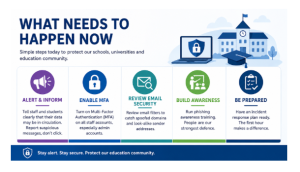
Organisations connected to the Australian education sector, such as schools, universities, and their technology partners, should be taking the following steps:
- Alert staff and students immediately. Tell them clearly and without jargon that their data may be in circulation and that suspicious messages should be reported, not clicked.
- Enable MFA on all staff accounts, especially those with admin access to learning platforms.
- Review email security filters to catch spoofed domains and look-alike sender addresses.
- Run phishing awareness sessions. Human error remains one of the biggest vulnerabilities. Training helps reduce it.
- Have an incident response plan ready. If a credential is compromised, the response in the first hour matters enormously.
What Protectera Thinks
The Canvas breach is a reminder that cybercriminals do not wait for organisations to catch up. They move fast, they use the tools available to them, including AI, and they exploit trust. A message that looks like it came from a teacher, a principal, or a department head is now entirely within the reach of a motivated attacker.
Educational institutions need layered security, not just awareness posters. That means technical controls, regular testing, and staff who know what to do when something looks off.
Ready to strengthen your organisation’s defences? At Protectera, we guide organisations through cyber risk assessments, phishing resilience programmes, and managed security services built for today’s threat environment.
Speak with our cybersecurity team today to understand how your organisation can reduce its exposure before an attack lands. Call us on 02 7227 5428 or book a free 30-minute consultation. Also, follow us on LinkedIn to stay across the latest in Australian cybersecurity.